Mold Remediation in Bellingham, WA — AMRT-Certified Crawl Space, Attic & Structural Mold Removal
Source-Corrected Mold Remediation That Doesn't Come Back — Serving Bellingham, Whatcom County & the Pacific Northwest Since 2015
If you've discovered mold in your crawl space, attic, basement, or behind walls in Bellingham, Boul Belling Restoration provides professional mold remediation in Bellingham, Washington, with IICRC AMRT-certified technicians. Our 30-person team follows the ANSI/IICRC S520 Standard for Mold Remediation — inspecting the moisture source, establishing negative-pressure containment, removing affected materials, treating surfaces with HEPA filtration, and verifying clearance — so mold doesn't return. If mold developed from a water event, our emergency water damage restoration team addresses the source alongside remediation.
- Local Bellingham, WA mold remediation company since 2015
- IICRC AMRT (Applied Microbial Remediation Technician) certified on staff
- Follows ANSI/IICRC S520 Standard for Mold Remediation on every project
- Serving Bellingham, Ferndale, Birch Bay, Sudden Valley, Lakeway, Meridian, and all of Whatcom County
No Obligation — Free Inspection & Assessment
Request Your Free Mold Assessment
Fill out the form and we'll contact you immediately!
Award-Winning Mold Remediation in Bellingham, Washington
Whatcom County's AMRT-certified mold removal and remediation team
Boul Belling Restoration is a fully certified mold remediation company with 10 years of experience addressing chronic and event-driven mold throughout Bellingham and Whatcom County. Led by Owner Ryan Swank, our team holds the IICRC Applied Microbial Remediation Technician (AMRT) certification — the industry-standard credential for mold inspection, containment, removal, air quality treatment, and clearance verification — along with the Health and Safety Technician (HST) certification for safe technician and occupant protocols in mold-contaminated environments.
AMRT Certified
Applied Microbial Remediation Technician — IICRC Certified
HST Certified
Health and Safety Technician — IICRC Certified
WRT Certified
Water Damage Restoration Technician — IICRC Certified (moisture source addressed alongside water damage restoration)
ASD Certified
Applied Structural Drying — IICRC Certified (post-removal structural drying)
30 Professionals
30 skilled restoration professionals, 5 fully equipped service vehicles
10 Years Serving
10 years serving Bellingham, WA and all of Whatcom County
S520 Compliant
Follows ANSI/IICRC S520 Standard for Mold Remediation on every project
Mold Remediation for Properties Near Bellingham's Historic Districts, Parks & Neighborhoods
From Fairhaven's historic crawl spaces to Barkley, Sehome, and Whatcom Falls
Boul Belling Restoration provides mold remediation throughout Bellingham, Washington — from older Victorian and Craftsman homes in Fairhaven near the Historic Fairhaven District and Pickett House with original crawl space construction and aging vapor barriers, to newer construction in Barkley, Cordata, and South Hill where condensation and ventilation shortfalls create modern mold conditions, to commercial properties near Downtown Bellingham and Western Washington University. Bellingham's Pacific Northwest climate creates year-round mold demand unlike seasonal-flood regions — the persistent drizzle from October through May keeps building materials damp enough to sustain mold growth without a single catastrophic water event triggering it.
Bellingham Neighborhoods
Cordata, Sehome, Barkley, South Hill, Columbia, Downtown Bellingham, Happy Valley, Whatcom Falls, Birchwood, Samish
Historic & Older Construction
Historic Fairhaven District, Pickett House, Roeder Home, Whatcom Museum / Old City Hall — properties with original crawl space construction vulnerable to Bellingham moisture conditions
Parks & Natural Areas
Whatcom Falls Park, Boulevard Park, Lake Padden Park, Sehome Hill Arboretum, Larrabee State Park, Padden Gorge
Education & Waterfront
Western Washington University, Whatcom Community College, Squalicum Harbor, Bellingham Bay
Nearby Service Areas
Ferndale, Lummi Nation, Birch Bay, Sudden Valley, Lakeway, Meridian, and surrounding Whatcom County communities
Bellingham's AMRT-Certified Mold Remediation Team — Source Correction First, Not Surface Treatment
Removing mold without correcting its moisture source guarantees it returns
The most important thing separating genuine mold remediation from surface cleaning is addressing the moisture source. Mold removed without identifying and correcting what's driving the moisture — a failed crawl space vapor barrier, inadequate attic ventilation, a roof leak, or elevated ambient humidity — will return in the same location. Our AMRT-certified technicians identify the actual moisture driver first, then apply the ANSI/IICRC S520-compliant remediation protocol that includes proper containment, removal, HEPA air treatment, and clearance verification. When mold originated from a below-grade flooding event, our team addresses the source and the mold under one certified response.
When Do Bellingham Homeowners Need Mold Remediation?
Pacific Northwest moisture creates chronic mold conditions, not just post-flood events
Bellingham mold rarely results from a single catastrophic flood. More often, it results from months of persistent drizzle keeping building materials damp, crawl spaces over wet ground without adequate vapor barriers, and older homes built before adequate bathroom and kitchen ventilation was standard. Mold can colonize within 24 to 48 hours of a moisture event — and in Bellingham's climate, that moisture event may be as gradual as elevated ambient humidity over an entire wet season. If mold developed following a water intrusion event, emergency water damage restoration should be addressed first to stop the source.
Signs You May Need Mold Remediation in Bellingham:
- A musty odor in your home or specific rooms, particularly after Bellingham's wet season
- Visible dark spots — black, green, or white patches — on walls, ceilings, bathroom tile, or basement surfaces
- Respiratory symptoms — increased allergies, asthma flare-ups, or coughing — with no other explanation
- A home inspection has identified mold in the crawl space, attic, or behind walls
- A recent water event has gone 24-48 hours without professional drying — mold colonization is already possible
- You're preparing to sell a Bellingham property and need documented mold clearance for the Washington State Seller Disclosure requirement
Who Our Mold Remediation Service Is For
Homeowners, landlords, buyers, sellers, and commercial property managers throughout Whatcom County
We provide mold remediation for single-family homes, rental properties, multi-unit residential buildings, and commercial properties throughout Bellingham and Whatcom County.
Bellingham Homeowners
Homeowners in Fairhaven, Birchwood, Happy Valley, and Sehome with crawl space or attic mold
Landlords & Property Managers
Landlords and property managers addressing mold in rental units or common areas throughout Whatcom County
Home Buyers
Home buyers whose inspection revealed mold requiring remediation before closing
Home Sellers
Home sellers needing documented mold clearance for Washington State Seller Disclosure compliance
Commercial Property Owners
Commercial property owners with mold in storage areas, utility rooms, or below-grade spaces
Persistent Musty Odor
Anyone who has experienced a musty smell or visible mold growth that hasn't resolved with surface cleaning
Why Bellingham, WA Has Among the Highest Residential Mold Risk in the Pacific Northwest
Chronic moisture, crawl space construction, and months without a drying cycle
Bellingham's Pacific Northwest climate delivers concentrated rainfall from October through May with minimal drying cycles between wet periods. The cool, damp conditions — often below 55°F for months — keep relative humidity elevated indoors and out, creating near-ideal conditions for mold growth in crawl spaces, attics, and wall cavities. Research and local data confirm that Bellingham experiences steady year-round demand for mold remediation, unlike regions where mold is primarily a post-storm seasonal problem. The city's high proportion of crawl space construction — common throughout Pacific Northwest building traditions — means many properties have below-floor environments with direct soil contact, minimal air exchange, and no barrier between damp ground and structural framing.
Persistent Wet Season
Bellingham's October-through-May wet season delivers persistent low-level moisture without adequate drying cycles between events
Crawl Space Construction
Crawl space construction over damp ground is the defining mold vulnerability factor for Pacific Northwest homes — without proper encapsulation, floor joists absorb moisture year-round
Pre-Modern Ventilation
Older Bellingham homes, particularly in Fairhaven and Whatcom Falls, were built before modern bathroom, kitchen, and crawl space ventilation standards were established
Elevated Ambient Humidity
Washington State's high ambient humidity keeps indoor surfaces near the moisture thresholds where mold growth is possible even without visible leaks
Crawl Space, Attic, Wall Cavity & HVAC Mold Remediation in Bellingham, WA
The location of mold determines the access, protocol, and cost of remediation
For mold remediation in Bellingham, the mold's location directly determines the equipment, access requirements, materials affected, and overall project scope.
| Mold Location | Why It Occurs | Typical Remediation Approach |
|---|---|---|
| Crawl Space Mold | Soil moisture, inadequate vapor barrier, poor ventilation | Full access crawl entry, HEPA vacuuming, antimicrobial treatment, vapor barrier assessment |
| Attic Mold | Roof leaks, inadequate attic ventilation, bathroom exhaust venting into attic | HEPA cleaning of wood framing, antimicrobial treatment, ventilation correction |
| Wall Cavity Mold | Hidden plumbing leaks, exterior moisture intrusion, condensation | Controlled drywall demolition, framing treatment, air scrubbing, rebuild |
| Basement Mold | High humidity, foundation seepage, water intrusion | Surface and structural cleaning, dehumidification, moisture source correction |
| Bathroom / Kitchen Mold | Chronic moisture from steam without adequate ventilation | Surface cleaning, ventilation improvement, tile and grout treatment |
| HVAC System Mold | Moisture in ductwork, condensation on coils | Duct cleaning, air handler treatment, HEPA filtration |
Crawl Space Mold
The most commonly reported residential case in Bellingham — crawl spaces over damp Pacific Northwest soil are the region's primary mold environment
Attic Mold
Common in older Bellingham homes where bathroom exhaust fans were vented into attic space rather than exterior — a common Pacific Northwest building practice
Wall Cavity Mold
Most likely to be discovered during a water damage restoration project — containment is critical to prevent spore spread during demolition
HVAC Mold
Requires complete duct cleaning alongside surface remediation — untreated ductwork will redistribute spores throughout the home during operation
Our 6-Step Mold Remediation Process in Bellingham, WA
From moisture source assessment to post-remediation clearance
Full Property Assessment & Moisture Mapping
We inspect all affected areas using moisture meters and, where needed, thermal imaging to locate mold within walls, beneath flooring, and in crawl spaces or attic assemblies — establishing the full scope before any removal begins.
Moisture Source Identification & Correction Plan
We identify the specific moisture driver — failed vapor barrier, roof leak, inadequate ventilation, plumbing leak, or chronic humidity — and provide a clear plan for correcting it before or alongside remediation.
Containment Setup
We establish negative-air-pressure containment using polyethylene barriers, isolating the work zone from unaffected areas of the property to prevent spore migration during removal.
Mold Removal & Affected Material Disposal
We remove contaminated materials — drywall, insulation, vapor barriers — using HEPA vacuuming and proper containment, then clean and treat all affected structural surfaces with antimicrobial solutions. If structural materials need replacement, our water damage repair team handles the rebuild.
HEPA Air Scrubbing & Dehumidification
We run HEPA air scrubbers throughout the work area to capture airborne spores, and deploy dehumidifiers to bring structural materials to proper moisture content before closure.
Post-Remediation Verification & Clearance
We conduct post-remediation air quality verification testing to confirm that spore levels have returned to acceptable baseline — the documented clearance that Washington State seller disclosures and insurance companies often require.
What's Included in Our Bellingham Mold Remediation Service
From moisture assessment to verified clearance
Our mold remediation service follows the ANSI/IICRC S520 Standard from assessment through clearance verification.
Bellingham's Trusted Mold Remediation Team
AMRT certification, moisture source correction, and post-remediation clearance included
When you compare mold remediation companies in Bellingham, Boul Belling Restoration stands out for the AMRT certification that backs our protocol, the consistent inclusion of moisture source correction rather than just mold removal, and the post-remediation verification that genuinely confirms successful clearance.
10 Years Serving
Bellingham, WA and Whatcom County
AMRT & HST Certified
Compliant mold remediation and occupant safety
S520 Standard
ANSI/IICRC S520 on every project
30 Professionals
In-house team, 5 equipped vehicles
Clearance Testing
Documented for insurance and WA seller disclosures
What Certified Mold Remediation Achieves in Bellingham, WA
From active mold colonization to documented clearance
Our Bellingham mold remediation projects consistently show the difference between surface treatments that mask the problem and genuine AMRT-certified remediation that addresses the source and prevents return.
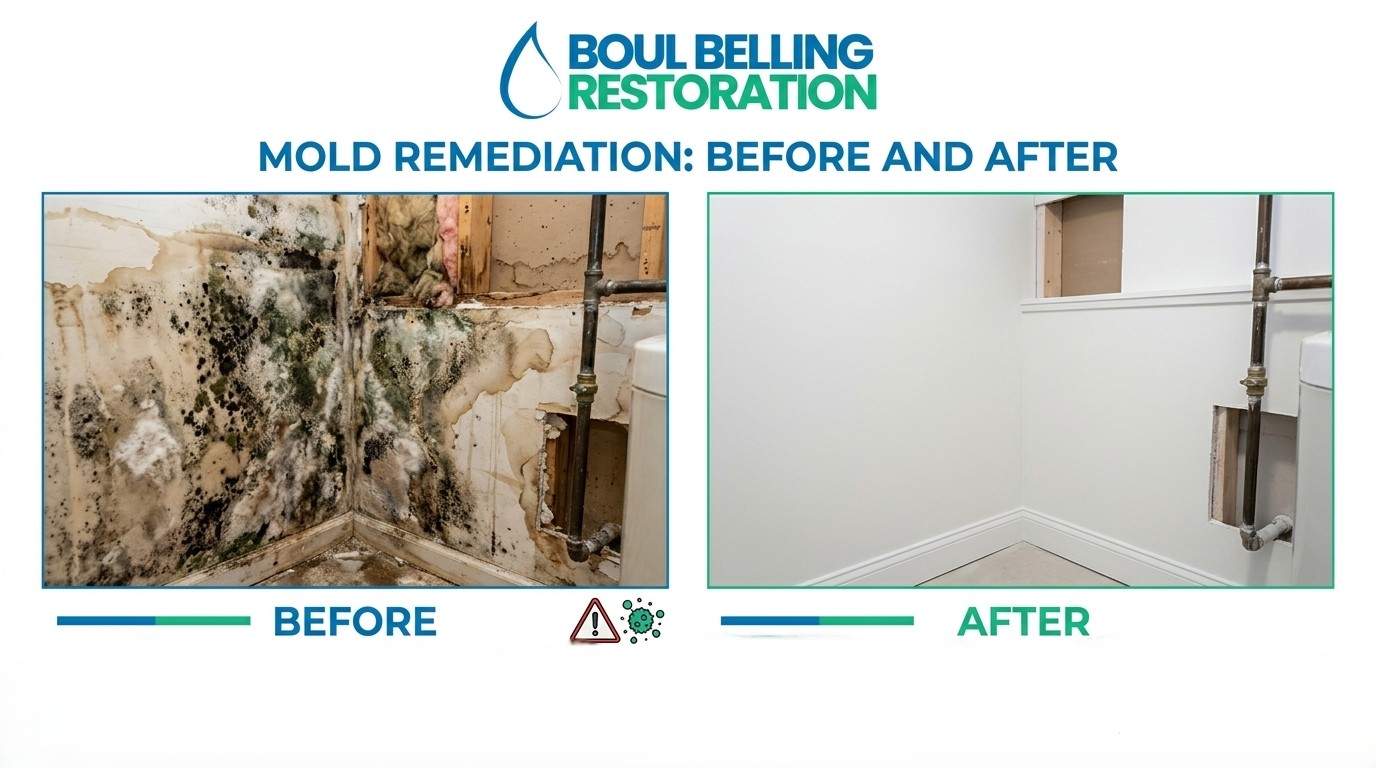
Fairhaven — Crawl Space Remediation
A Fairhaven crawl space with years of accumulated mold on floor joists and subfloor sheathing remediated, vapor barrier replaced, and moisture source corrected — no recurrence
Birchwood — Attic Mold
A Birchwood attic mold problem traced to a bathroom exhaust fan vented into the attic space, remediated and rerouted to exterior to prevent recurrence
Sehome — Wall Cavity Discovery
A Sehome home's wall cavity mold discovered during a water damage repair project, contained and remediated before the rebuild phase began
Happy Valley — Seller Disclosure
A Happy Valley rental property given documented post-remediation clearance for Washington State seller disclosure before an upcoming sale
Mold Remediation Equipment and Methods in Bellingham, WA
ANSI/IICRC S520-compliant equipment for complete mold removal and air treatment
We use AMRT-certified methods and professional-grade equipment for every mold remediation project in Bellingham.
HEPA Vacuums
Surface mold removal without releasing spores into the air — critical for containment integrity
HEPA Air Scrubbers
Negative air machines for spore capture during removal — maintaining containment zone air quality
Moisture Detection
Moisture meters and thermal imaging cameras for pre- and post-remediation moisture verification
Containment Systems
Polyethylene containment barriers and negative-pressure systems for work zone isolation
Antimicrobial Treatment
EPA-registered antimicrobial solutions for surface treatment of affected structural materials
Air Sampling Equipment
Post-remediation air sampling equipment for clearance verification testing
Mold Removal vs. Mold Remediation: What Bellingham Homeowners Need to Know
The distinction that determines whether mold comes back
"Mold removal" refers specifically to removing visible mold growth from surfaces. "Mold remediation" follows the ANSI/IICRC S520 Standard — it addresses the moisture source, removes affected materials, treats the environment, and verifies clearance. In Bellingham's persistently damp climate, mold removal without full S520-compliant remediation almost always results in mold returning, because the underlying moisture condition that enabled growth remains.
| Approach | What It Does | What It Misses |
|---|---|---|
| Surface Mold Removal | Removes visible mold on accessible surfaces | Moisture source, hidden mold in cavities, spore count verification |
| ANSI/IICRC S520 Mold Remediation (Boul Belling) | Full protocol: source correction, removal, air treatment, clearance verification | Nothing — remediation is complete to documented standard |
Why Surface Treatment Fails in Bellingham:
- Bellingham's chronic moisture conditions mean mold returns within weeks to any surface where the moisture source wasn't corrected
- Bleach applied to mold on porous surfaces kills surface cells but doesn't penetrate the root structure — mold returns from below
- Without negative-pressure containment, disturbing mold on surfaces spreads spores to unaffected rooms
- Without post-remediation clearance testing, there is no verification that the project achieved its goal
Estimate Your Mold Remediation Cost in Bellingham, WA
From a contained surface problem to major structural remediation
We provide a free mold inspection and assessment with transparent, documented pricing before any work begins.
Main Cost Drivers:
- Mold location: crawl space and attic projects typically cost more due to access difficulty
- Affected square footage and depth of penetration into structural materials
- Whether containment of adjacent areas is required
- Whether structural materials — insulation, drywall, vapor barriers — need replacement
- Whether HVAC cleaning is needed alongside structural remediation
| Remediation Scope | Typical Range |
|---|---|
| Small surface mold (bathroom, under sink) | ~$500 – $2,000 |
| Crawl space mold remediation (small) | ~$500 – $2,000 |
| Crawl space mold remediation (extensive) | ~$2,000 – $6,000+ |
| Basement mold remediation | ~$500 – $3,000 |
| Attic mold remediation | ~$1,000 – $7,000 |
| Wall cavity mold (with drywall removal) | ~$1,000 – $20,000 |
| HVAC system mold | ~$3,000 – $10,000 |
| Mold testing / air quality assessment | ~$250 – $350 |
Local Data Note: Most Bellingham homeowners pay $1,500 to $6,500 for mold remediation. Average for medium projects (10-30 sq ft) is approximately $2,500.
Who Needs Professional Mold Remediation in Bellingham, WA?
When surface cleaning has failed or full remediation is required
We recommend professional AMRT-certified mold remediation whenever mold is present in structural materials, wall cavities, crawl spaces, or HVAC systems — or whenever a previous surface treatment hasn't prevented recurrence.
You've noticed visible mold growth that keeps returning despite surface cleaning
A home inspection has identified mold in your crawl space, attic, or behind walls
You're experiencing a persistent musty odor with no visible cause
Household members have unexplained respiratory symptoms that improve away from home
You're selling a Bellingham property and need documented clearance for Washington State seller disclosure
A water event was not professionally dried within 24-48 hours and mold risk is now elevated
Benefits of Certified Mold Remediation in Bellingham, WA
AMRT certification and the ANSI/IICRC S520 Standard protect your home and your health
Professional, AMRT-certified mold remediation following the ANSI/IICRC S520 Standard determines whether the mold is genuinely gone, whether it will return, and whether your indoor air quality has been genuinely restored.
Source Correction
S520-compliant remediation addresses the moisture source, preventing recurrence in the same location
Containment Protection
Negative-pressure containment during removal prevents mold from spreading to unaffected areas of your home
Verified Clearance
Post-remediation clearance testing is the only reliable verification that indoor air quality has been restored
Seller Disclosure Protection
Washington State requires mold disclosure on seller statements — documented clearance protects your position
Occupant Safety
HST certification ensures occupant and technician safety in mold-contaminated environments
Safety Alert: Don't Disturb Mold Without Proper Containment
Disturbing mold without negative-pressure containment spreads spores throughout your home
The most common mold-related mistake Bellingham homeowners make is attempting to clean or remove mold without proper containment. When mold colonies are disturbed without negative-air-pressure barriers, spores become airborne and can spread to previously unaffected rooms, dramatically expanding the remediation scope and the health risk. In Bellingham's older homes, Stachybotrys (commonly called black mold) may be present and requires enhanced containment protocols.
- Don't Disturb Without Containment: Do not disturb visible mold growth with vacuuming, scrubbing, or demolition before professional containment is established
- Bleach Doesn't Work on Porous Surfaces: Bleach on porous surfaces like drywall or wood kills surface cells but does not penetrate root structures — mold returns from below
- Crawl Space Air Quality Risk: If mold is visible in a crawl space, do not enter without appropriate respiratory protection — confined, mold-contaminated spaces pose genuine air quality risks
- Renovation Discovery: Mold discovered during a home renovation or demolition project must be contained immediately before work continues — uncontained disturbance can make a contained problem a whole-house problem
- Legal Exposure: Washington State requires sellers to disclose known mold — attempting to cover or paint over mold before a sale creates legal exposure
Mold Remediation FAQs for Bellingham, WA Property Owners
Answers about cost, crawl space mold, clearance testing, and Bellingham's mold climate
Most Bellingham homeowners pay $1,500 to $6,500, with an average around $2,500 for medium-scope projects. Crawl space and attic projects typically run $500 to $6,000+ depending on extent and access. HVAC system mold is the most expensive at $3,000 to $10,000. Call (253) 550-0564 for a free assessment.
Crawl space construction is standard in Pacific Northwest homes, and Bellingham's persistent wet season keeps soil moisture and humidity elevated for months without drying cycles. Without an adequate vapor barrier and ventilation system, crawl spaces over damp Pacific Northwest ground become year-round mold environments. Our basement and crawl space flood cleanup service often reveals mold requiring remediation alongside the water extraction.
Mold removal addresses only visible surface mold. Mold remediation follows the ANSI/IICRC S520 Standard — correcting the moisture source, removing mold and affected materials, treating the environment with HEPA filtration, and verifying clearance through post-remediation testing. In Bellingham's climate, only full remediation prevents recurrence.
Washington State's Seller Disclosure Statement requires disclosure of known mold and water damage. Documented post-remediation clearance testing from a certified contractor provides the verified documentation needed to demonstrate that a previously known issue has been fully and professionally addressed.
Yes. Firefighting water introduces significant moisture into a structure, and in Bellingham's already humid Pacific Northwest climate, mold can develop within days of a fire event if the structure isn't properly dried. Our team handles both fire damage restoration and mold remediation from post-fire moisture under one certified response.
Our Bellingham Mold Remediation Guarantee
AMRT-certified remediation that addresses the source, not just the surface
Boul Belling Restoration stands behind every mold remediation project in Bellingham, WA with IICRC AMRT-certified protocol, ANSI/IICRC S520 compliance, and our own satisfaction guarantee. When we remediate mold in your home or business, we correct the moisture source that allowed it to grow — so the same location doesn't require retreatment within a season.
Since 2015, property owners across Bellingham — from historic Fairhaven crawl spaces to attics throughout Barkley, Cordata, and Happy Valley — have trusted Boul Belling Restoration for complete mold remediation in Bellingham, WA that genuinely improves their indoor air quality and protects their property long-term. Whether mold developed after a water damage event or from chronic Pacific Northwest moisture, and whether structural repair is needed after removal, we handle the full scope.
Mold Remediation Bellingham WA — Service Area Coverage
When responding to mold remediation in Bellingham, our AMRT-certified team understands the crawl space construction prevalent near Whatcom Falls and Sudden Valley, the chronic humidity affecting homes near Birch Bay, and the year-round mold demand across all of Whatcom County.
Cities We Serve for Mold Remediation Near Bellingham WA
We Serve All Bellingham WA Neighborhoods for Mold Remediation
Get Mold Remediation in Bellingham WA Now
Need mold remediation in Bellingham WA? Our 30 AMRT-certified professionals are ready to assess your property. If you need information about our full range of restoration services, please reach out.
Contact Boul Belling Restoration
(253) 550-0564
boulbellingrestoration@gmail.com
110 Forest Ln
Bellingham, WA 98225
24/7 Emergency Service Available